
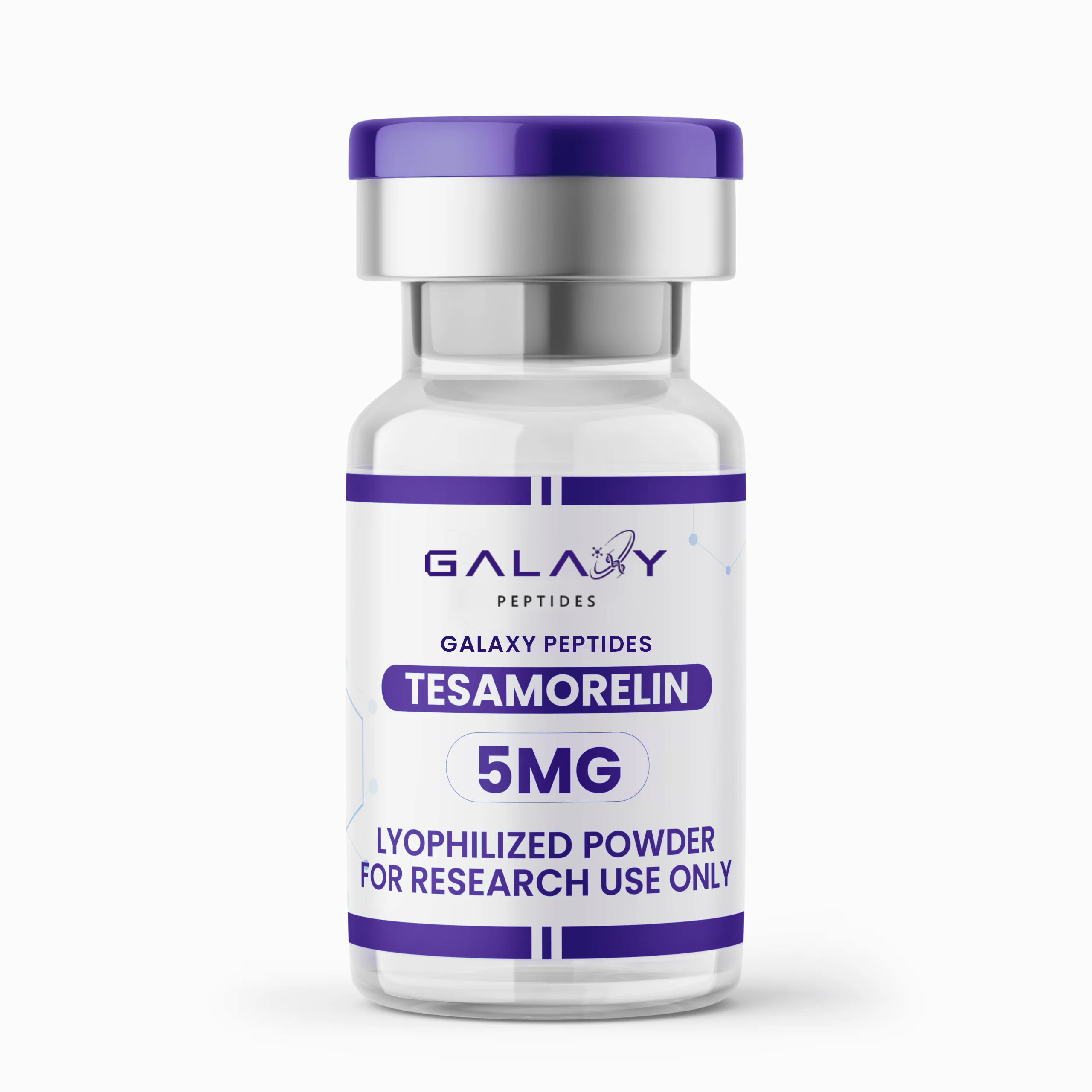
Tesamorelin is a synthetic analog of growth hormone-releasing hormone (GHRH), engineered to resist rapid enzymatic breakdown so it can more effectively stimulate the pituitary gland’s natural GH-release pathway. It’s one of the most extensively studied compounds in the GHRH-analog category, with a body of published clinical research behind it.
This guide covers the tesamorelin peptide’s structure, mechanism of action, and the research findings that have made it a frequent reference point in growth-hormone-axis studies.
What Is Tesamorelin?
Tesamorelin is a 44-amino-acid peptide modeled on human GHRH(1-44), the endogenous hormone responsible for signaling the pituitary gland to release growth hormone. A trans-3-hexenoic acid modification at the N-terminus gives tesamorelin greater resistance to degradation by the enzyme DPP-4, extending its functional half-life relative to native GHRH.
Because of this stability improvement, tesamorelin is a common reference compound in research examining GHRH-receptor activity, pituitary GH pulsatility, and downstream IGF-1 signaling.
Mechanism of Action
Tesamorelin acts on the GHRH receptor (GHRH-R) located on somatotroph cells in the anterior pituitary. Receptor activation triggers the synthesis and pulsatile release of growth hormone, which in turn stimulates hepatic production of insulin-like growth factor 1 (IGF-1) — a downstream marker researchers frequently measure to gauge GH-axis activity.
Unlike GHRP-class secretagogues (such as ipamorelin), which act through the ghrelin receptor (GHS-R1a), tesamorelin works upstream on the GHRH pathway itself. This distinction is a common comparison point in peptide-stacking research, since the two mechanisms are considered complementary rather than overlapping.
What the Published Research Shows
Tesamorelin carries a more extensive clinical research record than many peptides in this category, having been studied in randomized, placebo-controlled trials examining visceral adipose tissue and GH/IGF-1 axis parameters in specific patient populations. It is also referenced in cognitive-aging research exploring the GH axis’s relationship to age-related changes.
It’s worth noting that tesamorelin (as the branded pharmaceutical Egrifta®) holds FDA approval for a narrow, specific clinical indication under physician supervision. The research-grade tesamorelin peptide sold for laboratory use is a distinct product from the approved pharmaceutical — it is not manufactured, labeled, or intended for human administration, and any research use should follow institutional and regulatory research-chemical protocols.
Tesamorelin vs. GHRP-Class Peptides
- Receptor target: Tesamorelin → GHRH-R. Ipamorelin/GHRP-6/GHRP-2 → GHS-R1a (ghrelin receptor).
- Selectivity profile: Tesamorelin’s mechanism is inherently GH-axis specific, since it mimics the body’s own releasing hormone.
- Research use pattern: Often studied alongside GHRP-class peptides to examine combined effects on GH pulsatility, since the two pathways converge on the same downstream GH release.
Stability, Storage & Handling
Tesamorelin is supplied lyophilized and requires reconstitution with bacteriostatic water prior to laboratory use. As with other GH-axis peptides, protecting the reconstituted solution from heat, light, and repeated freeze-thaw cycles is essential to preserving peptide integrity across a study timeline.
See our reconstitution guide for a full step-by-step walkthrough of proper handling technique.
Frequently Asked Questions
What class of peptide is tesamorelin?
Tesamorelin is a synthetic GHRH (growth hormone-releasing hormone) analog, distinct from ghrelin-receptor-targeting GHRP peptides like ipamorelin.
How does tesamorelin differ from ipamorelin?
The two act on different receptors — tesamorelin on GHRH-R, ipamorelin on GHS-R1a — which is why researchers often study them together to examine combined effects on GH release.
Is research-grade tesamorelin the same as the FDA-approved drug?
No. The approved pharmaceutical (Egrifta®) is manufactured and indicated for a specific clinical use under medical supervision. Research-grade tesamorelin is sold strictly for laboratory research and is not intended for human administration.
View our tesamorelin peptide listing for laboratory research use.
https://galaxypeptide.com/product/tesamorelin/





