
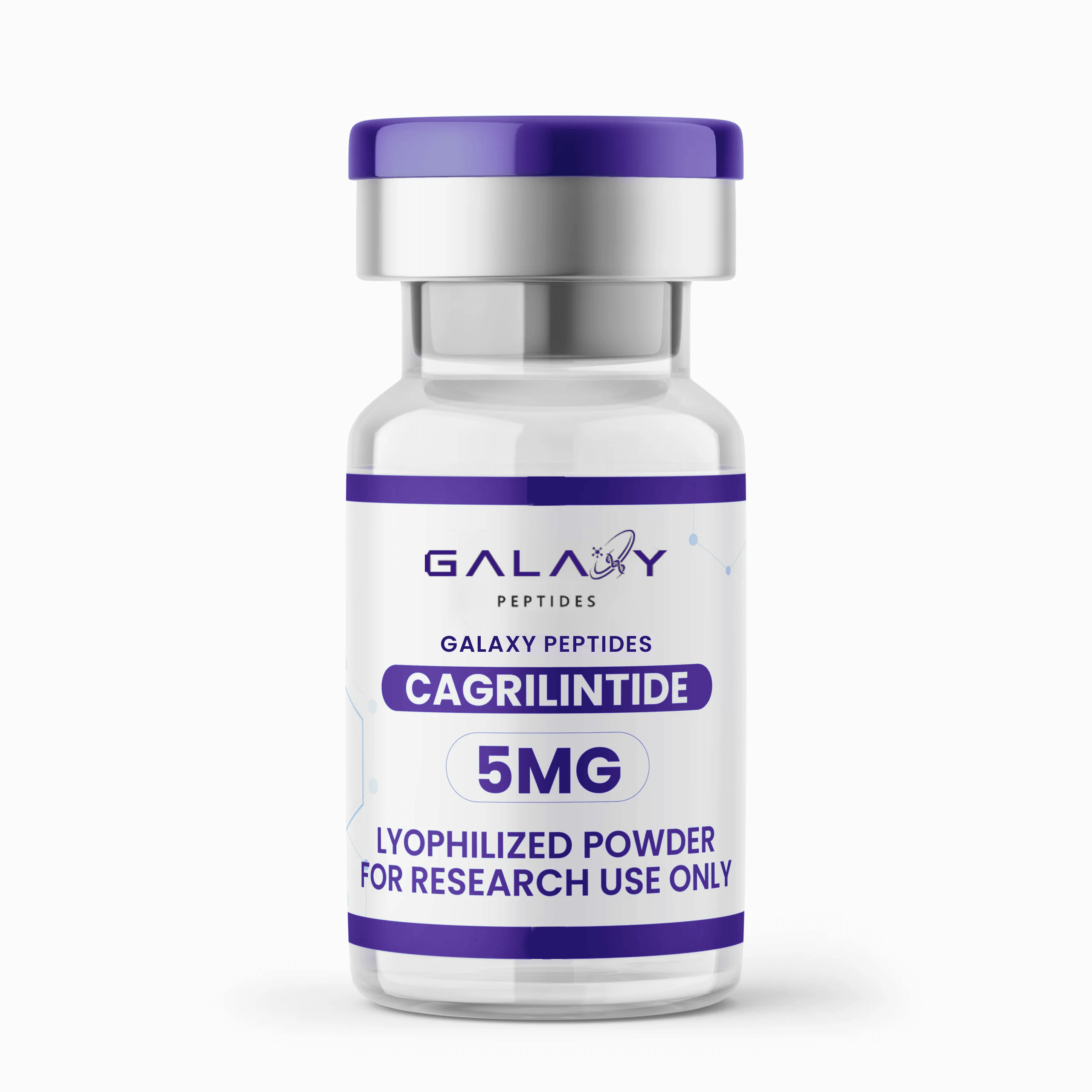
Cagrilintide is a long-acting synthetic analog of amylin, a hormone co-secreted with insulin by pancreatic beta cells. It has become one of the most closely watched compounds in metabolic peptide research, largely due to its role in combination studies alongside GLP-1 receptor agonists like semaglutide.
This guide explains what cagrilintide is, how amylin-receptor signaling works, and what the current research pipeline shows.
What Is Cagrilintide?
Amylin is a naturally occurring peptide hormone that plays a role in regulating gastric emptying, glucagon secretion, and satiety signaling — working in concert with insulin to help manage post-meal glucose and appetite regulation. Native amylin, however, has a very short half-life, which limits its usefulness as a standalone research tool.
Cagrilintide was engineered to address that limitation. Through fatty-acid acylation (a modification technique also used in long-acting GLP-1 analogs), cagrilintide binds to albumin in the bloodstream, dramatically extending its functional half-life and enabling once-weekly dosing schedules in clinical trial protocols.
Mechanism of Action
Cagrilintide acts as an agonist at amylin receptors, which are expressed in areas of the brainstem and hypothalamus involved in appetite regulation. Activation of these receptors is associated with slowed gastric emptying and increased satiety signaling — mechanisms distinct from, but complementary to, the GLP-1 receptor pathway.
Because amylin and GLP-1 signaling act on different but converging appetite-regulation circuits, cagrilintide is frequently studied in combination with GLP-1 receptor agonists to examine whether dual-pathway activation produces additive or synergistic effects in metabolic research models.
The CagriSema Research Pipeline
Cagrilintide has drawn significant research attention as one half of CagriSema, a combination compound pairing cagrilintide with semaglutide, currently being studied by Novo Nordisk in clinical trials examining metabolic and body-weight-related endpoints.
Published trial data on cagrilintide, both as a standalone compound and in combination with semaglutide, has reported measurable effects on body weight in study populations relative to placebo. As with any compound still in active clinical trial phases, findings continue to evolve, and researchers should reference primary trial publications and registries (such as ClinicalTrials.gov) for the most current data rather than relying on secondary summaries.
Cagrilintide vs. GLP-1 Agonists
- Receptor target: Cagrilintide → amylin receptor. Semaglutide/tirzepatide → GLP-1 receptor (tirzepatide also targets GIP).
- Mechanism emphasis: Amylin-pathway research focuses heavily on satiety and gastric emptying; GLP-1 pathway research spans glucose regulation, satiety, and broader metabolic signaling.
- Research application: The two are increasingly studied in combination rather than in isolation, given their complementary receptor targets.
Stability, Storage & Handling
Cagrilintide is supplied as a lyophilized peptide and must be reconstituted with bacteriostatic water before laboratory use. Given its role in longer-duration research protocols, consistent cold storage and careful handling are especially important to preserve the compound’s stability profile across a study period.
For proper preparation technique, see our step-by-step reconstitution guide.
Frequently Asked Questions
What hormone does cagrilintide mimic?
Cagrilintide is a long-acting analog of amylin, a hormone naturally co-secreted with insulin that plays a role in satiety and gastric emptying regulation.
Is cagrilintide the same as semaglutide?
No. They target different receptors — cagrilintide acts on amylin receptors, while semaglutide acts on GLP-1 receptors. The two are being studied together as the combination compound CagriSema.
Is cagrilintide FDA-approved?
No. Cagrilintide remains in clinical trial phases and is not an FDA-approved drug. It is sold and studied strictly as a research chemical for laboratory use.
Browse our cagrilintide peptide listing for laboratory research use.
https://galaxypeptide.com/product/cagrilintide/





